Monthly Archives: November 2023

The Basis Isolation Backdoor Roth IRA

If you have basis in an IRA, you will want to read this post. Basis in an IRA creates all sorts of confusion, but it also presents a great planning opportunity for many of those still working. I refer to this opportunity as the Basis Isolation Backdoor Roth IRA. 

Where Does IRA Basis Come From?

Basis in a traditional IRA generally emerges from two sources. The first source is old nondeductible traditional IRA contributions that have not been Roth converted or withdrawn. Nondeductible traditional IRA contributions should be reported on a Form 8606 filed with one’s annual federal income tax return. 

Many times this basis is simply exhausted annually by Backdoor Roth IRAs. Here’s a quick example:

Example 1: Becky contributed $6,500 to a traditional, nondeductible IRA on January 2, 2023. On February 1, 2023, when the traditional IRA was worth $6,504, she converted the entire traditional IRA balance to a Roth IRA. On December 31, 2023, she had $0 in all traditional IRAs, SEP IRAs, and SIMPLE IRAs. She successfully completed the Backdoor Roth IRA, which created $6,500 of IRA basis on January 2nd and exhausted all $6,500 of that basis on February 1st.

However, there are plenty of Americans who have existing and remaining IRA basis because they can’t do the Backdoor Roth IRA efficiently, or they never did the Backdoor Roth IRA. 

To sum up, those doing annual tax-efficient Backdoor Roth IRAs tend not to have any IRA basis at year-end. But some Americans do have existing and remaining IRA basis.

The second source of IRA basis is from after-tax 401(k) contributions that have been transferred to a traditional IRA (see Natalie B. Choate’s treatise Life and Death Benefits for Retirement Planning (8th Ed. 2019), page 150). 

There are Americans with existing IRA basis through transfers from a 401(k) (or other qualified plan) to a traditional IRA. However, going forward this should generally not occur. The IRS and Treasury issued Notice 2014-54, which provides that after-tax 401(k) contribution amounts can be rolled directly to a Roth IRA. From a planning perspective, after-tax 401(k) contributions (and other qualified plan after-tax contributions) should generally be directed into Roth IRAs if the plan participant prefers to exit the plan for IRAs (at retirement or a job change, for example). 

Example 2: Chris is age 53. He leaves employment at Consolidated Industries, Inc. on November 1, 2023. At that time, he had a traditional 401(k) at Consolidated worth $500,000. During his time at Consolidated, Chris made $75,000 of after-tax contributions to the traditional 401(k) which remain in the traditional 401(k). Chris prefers to manage the money himself in an IRA or IRAs. Thus, he has two options:

Option One: Transfer the money (preferably through a direct trustee-to-trustee transfer) to a single traditional IRA. Chris now has $75,000 of traditional IRA basis. 

Option Two: Transfer (preferably through direct trustee-to-trustee transfers) the after-tax money $75,000 to a Roth IRA and $425,000 to a traditional IRA. The $75,000 goes into the Roth IRA as a nontaxable conversion contribution (see also Notice 2014-54 Example 4). Chris receives no basis in his traditional IRA.

Which option is better for Chris? Clearly it is Option Two, which gives Chris tax-free growth on his $75,000. Further, Chris can withdraw the $75,000 from the Roth IRA tax and penalty free at any time while Chris would be subject to the hard bite of the Pro-Rata Rule if he used Option 1 and later withdrew $75,000 from the traditional IRA. Thus, while Chris is allowed to roll his $75K 401(k) basis into a traditional IRA, he would be much better served to roll the basis tax-free into a Roth IRA. 

A Current Employer Qualified Plan That Accepts Rollovers

In order to have an IRA basis isolation opportunity, one must be currently employed by an employer with a qualified plan (often a 401(k)) that accepts IRA roll-ins. Many qualified plans accept IRA roll-ins but not all do

Former employees generally are not able to contribute to 401(k)s and other qualified plans, so having a 401(k) plan at a former employer is generally not sufficient for this planning opportunity. 

One should generally employ the Basis Isolation Backdoor Roth IRA if they have a 401(k) or other qualified plan at work they are satisfied with from both an investment choice standpoint and a fee standpoint. If one isn’t satisfied with their workplace retirement plan the Basis Isolation Backdoor Roth IRA may not be a good tactic to employ. 

Comprehensive Basis Isolation Backdoor Roth IRA Case Study

Having addressed the two prerequisites to do a Basis Isolation Backdoor Roth IRA, let’s dive in with a comprehensive case study. 

Imagine Ray has two (and only two) traditional IRAs. IRA 1 is a $100K traditional IRA rollover from an old 401(k). No basis came along in the rollover into IRA 1. IRA 2 is a traditional IRA worth $25K. It was established with three $6K nondeductible traditional IRA contributions for 2020 through 2022. He filed Forms 8606 reporting those contributions. 

Ray’s current employer (Acme) has a great 401(k) that accepts roll-ins of traditional IRAs. What could Ray do to take advantage of his traditional IRA basis? He will need to isolate that basis, and that’s where the Basis Isolation Backdoor Roth IRA comes in. 

Step 1

Ray transfers IRA 1 to the Acme 401(k), preferably through a direct trustee-to-trustee transfer. 

Step 2

Ray invests about $18,010 of IRA 2 in a money market account and invests the remainder of IRA 2 in any investment of his choice (Mutual Fund A).* 

By putting that $18,000 and a bit of change in a money market, Ray makes sure he “leaves behind” the IRA basis in the IRA! We will come back to why this “leave behind” asset is so critically important in the Step 3 discussion and analysis. 

* As a practical matter, it may be easier to split IRA 2 into IRA 2 and IRA 3, with the $18,010 in IRA 2 and Mutual Fund A in IRA 3. Either path can work, but splitting into IRA 2 and IRA 3 may be the easier path. That split should be done internally at the IRA 2 institution without any check coming out of IRA 2 to the owner.  

Step 3

Ray transfers the entire value of Mutual Fund A to the Acme 401(k), preferably through a direct trustee-to-trustee transfer. 

The money market account is crucial. The Internal Revenue Code provides that IRA basis cannot be transferred to a 401(k) (see also Natalie B. Choate’s treatise Life and Death Benefits for Retirement Planning (8th Ed. 2019), page 158). By establishing that IRA 2 will have at least $18K that will not be moved into the 401(k), Ray ensures that he “leaves behind” at least his basis inside the IRA. 

If the $18,010 was invested in an equity mutual fund (call it Mutual Fund B), there’s a risk that when Ray does Step 3 he will leave behind only Mutual Fund B, which could be less than his $18K basis if Mutual Fund B declines in value.

Example 3: Imagine Ray does Step 3 when Mutual Fund A is worth $10K and Mutual Fund B, originally worth $18K is now only worth $14K based on market declines. In such a case, $4K of basis would (theoretically) move into the Acme 401(k) with the $10K going from IRA 2 to the Acme 401(k). That would be a prohibited transfer of basis. 

IRA Aggregation: Remember that for tax purposes, the IRS looks at all of Ray’s traditional IRAs (whether he has one or ten) as a single traditional IRA. We can’t say that basis attaches to IRA 2 only, so it is important that Ray leave at least $18K behind in an IRA so that after the transfers from his IRAs to qualified plans he can demonstrate that his basis was left behind in one or more of his traditional IRAs. 

Step 4

Step 4: Ray converts the entire remaining balance in IRA 2 (likely to be $18,010 plus a bit of additional interest) to a Roth IRA. The only taxable amount is the small amount over $18,000.

Step 4 is reported on a Form 8606 (Parts 1 and 2). 

Step 5

Ray ensures that as of December 31st of the year Step 4 occurs, Ray has $0 balances in all traditional IRAs, SEP IRAs, and SIMPLE IRAs. 

The Benefits of the Basis Isolation Backdoor Roth IRA

Ray has moved approximately $107K from traditional IRAs to the Acme 401(k). That is entirely tax free and does not change the future tax treatment of that money. Perfectly fine, but by itself this doesn’t improve Ray’s tax position.

Before this planning, Ray had $18K of IRA basis that was of limited value due to the Pro-Rata Rule. Future taxable distributions or conversions from his traditional IRAs would have picked up only a small portion of that $18K, meaning that it would only protect small portions of future distributions and conversions from current taxation. 

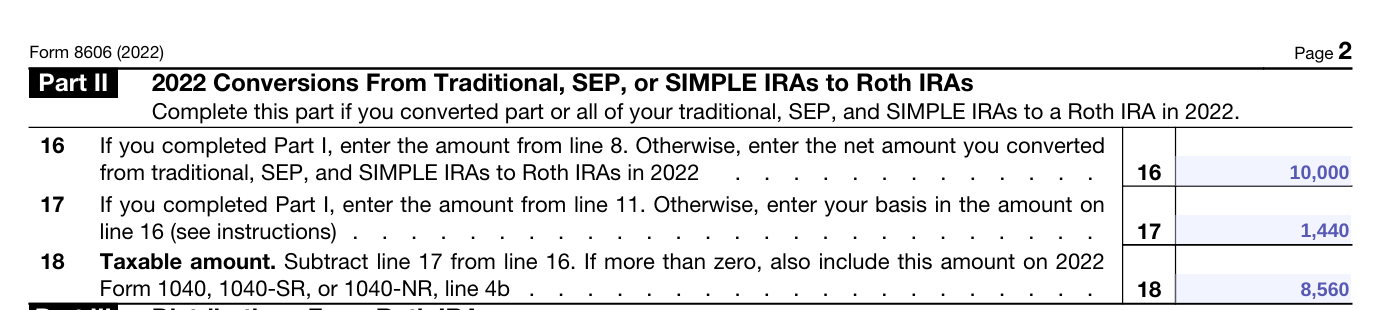
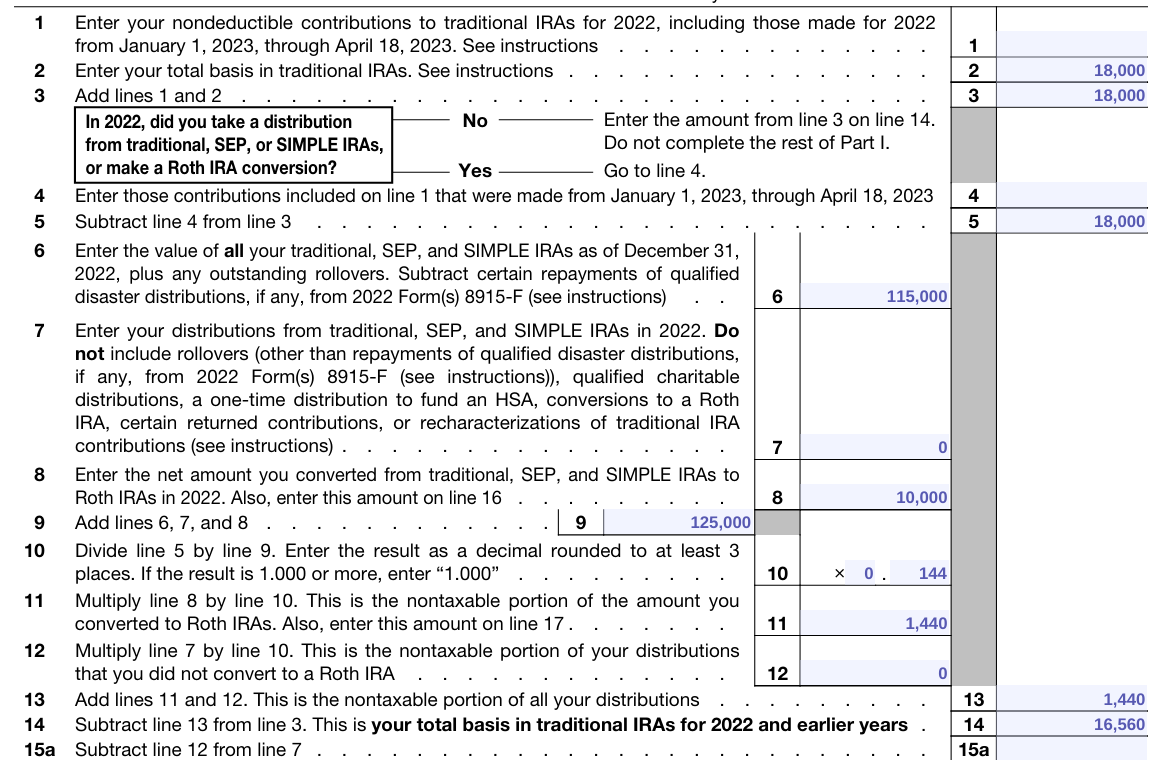
Example 4 The Pro-Rata Rule Bites Ray: If Ray had $18K of basis and $125K of total traditional IRAs and decided to do a $10K Roth conversion (without first doing the Basis Isolation Backdoor Roth IRA), approximately $1,440 of that Roth conversion would have been tax free and approximately $8,560 would have been taxable. See the mock Form 8606 Part I here and Form 8606 Part II here (though note that tax return software programs may use a separate statement instead of actually completing the form). 

But with the Basis Isolation Backdoor Roth IRA Ray puts $18K plus into a Roth IRA and paid almost no tax to do so! Ray successfully isolated all $18,000 of basis to get it all into a Roth IRA without being adversely affected by the Pro-Rata Rule. Further, that $18,000 can now grow tax free for the rest of Ray’s life. Previously, inside a traditional IRA that $18,000 was growing tax-deferred, not tax free. 

The Basis Isolation Backdoor Roth IRA improved Ray’s position by getting around the Pro-Rata Rule to get $18K plus into a Roth IRA for hardly any income tax. The only tax Ray pays is on the small amount the conversion amount in Step 4 exceeds $18,000.

The Basis Isolation Backdoor Roth IRA also opens another future tax planning opportunity. Going forward, Ray can do annual Backdoor Roth IRAs in a tax-efficient manner because he cleaned out his traditional IRAs into his workplace 401(k). 

Practical Considerations

The Basis Isolation Backdoor Roth IRA is not a tactic to be affirmatively planned into. Rather, it is a clean up tactic. It makes the best of a situation where one has both basis and pretax amounts in traditional IRAs. The Backdoor Roth IRA is an affirmative planning technique, though it may require similar clean-up steps prior to implementation. 

This planning is sophisticated and benefits from professional assistance. I recommend that most work with a professional if they are considering this sort of planning. Further, this planning does not occur every day. My experience suggests that most professionals are unfamiliar with this type of planning. Professionals will need to review resources such as this blog post and other sources and measure two or three times to dot I’s and cross T’s on this type of planning. 

Of course, this blog post is not advice for the reader or any particular individual. 

Additional IRA Basis and IRA Basis Isolation Resource

I went into detail on this planning in a June 2023 Measure Twice Planners presentation. While the presentation is mostly geared towards advisors, I hope I presented it in such a way that layman can also understand much of it and get value from it. The presentation and its slides, like this particular post, are for educational purposes only and are not intended as advice for any particular individual. 

Conclusion

Existing basis in IRAs is a planning opportunity if the investor has a good workplace 401(k) or other qualified plan that accepts IRA roll-ins. That planning requires intention and diligence, and measuring two or three times, even if working with a professional. 

FI Tax Guy can be your financial planner! Find out more by visiting mullaneyfinancial.com

Follow me on X at @SeanMoneyandTax

This post is for entertainment and educational purposes only. It does not constitute accounting, financial, legal, investment, or tax advice. Please consult with your advisor(s) regarding your personal accounting, financial, legal, investment, and tax matters. Please also refer to the Disclaimer & Warning section found here.

2024 Solo 401(k) Update

There are some new developments in the world of the Solo 401(k). Here are the highlights:

New Solo 401(k) Employee Contributions Limit for 2024

The IRS announced that for 2024, the employee deferral limit for all 401(k)s, including Solo 401(k)s, will be $23,000. 

Solo 401(k) Catch-Up Contributions Limit for 2024

The IRS also announced that for 2024, the employee deferrals catch-up contribution limit remains $7,500. As a result, those aged 50 or older can contribute, in employee contributions, a maximum of the lesser of $30,500 ($23,000 plus $7,500) or earned income. 

New Solo 401(k) All Additions Limit for 2024

The new all-additions limit for Solo 401(k)s is $69,000 (or earned income, whichever is less). For those aged 50 or older during 2024, the $66,000 number is $76,500 ($69,000 plus $7,500). 

Wither Roth Employer Contributions?

One of the changes SECURE 2.0 ushered in was allowing Roth employer contributions to 401(k) plans, including Solo 401(k)s. Interestingly enough, three of the largest institutions offering Solo 401(k)s, Fidelity, Schwab, and Vanguard, have not added that feature to their Solo 401(k)s. Vanguard’s website goes so far as to affirmatively state it will not add the Roth employer contribution feature to their Solo 401(k) at this time. 

I mention this development to inform the reader, not to criticize Solo 401(k) providers. If you’ve read some of my other work, you may know I don’t think a lack of Roth employer contributions in Solo 401(k)s is a problem.

UPDATE March 2, 2024: Today I learned that Schwab now offers Roth employee contributions (a change) and Roth employer contributions (also a change). Based on this January 21, 2024 post, I suspect this change occurred prior to the federal district court’s publishing of its decision in Texas v. Garland on February 27, 2024.

Ambiguity on New Schedule C Solo 401(k) Funding Deadline

UPDATE December 14, 2023: I Tweeted a thread about the provision that allows Schedule C solopreneurs to establish and fund a new Solo 401(k) with an employee deferral contribution after year-end. There is at least some concern that if one is diligent enough to establish a new Solo 401(k) prior to year-end they might not get the benefit of Section 401(b)(2)‘s funding deadline extension. If that is true (and to my mind this is an ambiguous issue), then the solopreneur establishing the new Solo 401(k) prior to year-end would need to either fund the employee contribution prior to year-end or elect to make an employee deferral contribution prior to year-end.

UPDATE March 2, 2024: There’s new uncertainty when it comes to the new Solo 401(k) establishment deadline for Schedule C solopreneurs looking to make a first-time employee contribution. A federal district court in Texas held on February 27, 2024, in Texas v. Garland, that the House of Representatives did not have a sufficient Quorum when it passed the Omnibus, which includes SECURE 2.0 and the Solo 401(k) deadline extension in SECURE 2.0 Section 317. Here’s my X/Twitter thread on the case and here’s my YouTube video on the case. Stay tuned to my YouTube channel for future updates!

2024 Update to Solo 401(k): The Solopreneur’s Retirement Account

Solo 401(k): The Solopreneur’s Retirement Account explores the nooks and crannies of Solo 401(k)s. On page 16 of the paperback edition, I provide an example of the Solo 401(k) limits for 2022 if a solopreneur makes $100,000 of Schedule C income. Here is a revised version (in italics) of the example (with the footnote omitted) applying the new 2024 employee contribution limit:

Lionel, age 35, is self-employed. His self-employment income (as reported on the Schedule C he files with his tax return) is $100,000. Lionel works with a financial institution to establish his own Solo 401(k) plan and choose investments for the plan. Lionel can contribute $23,000 to his Solo 401(k) as an employee deferral (2024 limit) and can choose to contribute, as an employer contribution, anywhere from 0-20% of his self-employment income.

Lionel’s maximum potential tax-advantaged Solo 401(k) contribution for 2024 is $41,587! That is a $23,000 employee contribution and a $18,587 employer contribution. Note there’s no change in the computation of the employer contribution for 2024 in this example. 

On page 18 I provide an example of the Solo 401(k) contribution limits factoring in catch-up contributions. Here’s the example revised for 2024:

If Lionel turned 50 during the year, his limits are as follows:

  • Employee contribution: lesser of self-employment income ($92,935) or $30,500: $30,500
  • Employer contribution: 20% of net self-employment income (20% X $92,935): $18,587
  • Overall contribution limit: lesser of net self-employment income ($92,935) or $76,500: $76,500

Amazon Reviews

If you have read Solo 401(k): The Solopreneur’s Retirement Account, you can help more solopreneurs find the book! How? By writing an honest, objective review of the book on Amazon.com. Reviews help other readers find the book!

FI Tax Guy can be your financial planner! Find out more by visiting mullaneyfinancial.com

Follow me on Twitter at @SeanMoneyandTax

This post is for entertainment and educational purposes only. It does not constitute accounting, financial, legal, investment, or tax advice. Please consult with your advisor(s) regarding your personal accounting, financial, legal, investment, and tax matters. Please also refer to the Disclaimer & Warning section found here.
2024 IRA Contributions for Beginners

There are only three types of annual contributions to individual retirement accounts (“IRAs”). They are:

  • Traditional, nondeductible contributions
  • Traditional, deductible contributions
  • Roth contributions

This post discusses when a taxpayer can make one or more of these types of annual contributions.

Let’s dispense with what we are not talking about. This post has nothing to do with annual contributions to employer retirement plans (401(k)s and the like) and self-employed retirement plans. We’re only talking about IRAs. The Individual in “IRA” is the key – anyone can set up their own IRA. IRAs are not pegged to any particular job or self-employment.

The above list is the exhaustive list of the possible types of annual contributions you can make to an IRA. But there is plenty of confusion about when you are eligible to make each of the three types of annual contributions.

Why Contribute to an IRA?

Before we dive into annual contributions to IRAs, let’s discuss why you would consider contributing to an IRA. The main reason is to build up tax-deferred wealth (traditional IRAs) and/or tax-free wealth (Roth IRAs) for your future, however you define it: financial independence, retirement, etc. A second potential benefit is the ability to deduct some annual contributions to traditional IRAs. A third benefit is some degree of creditor protection. States offer varying levels of creditor protection to traditional IRAs and Roth IRAs, while the federal government provides significant bankruptcy protection for traditional IRAs and Roth IRAs. 

IRA Annual Contribution Requirement: Earned Income

In order to make any of the three types of IRA annual contributions for any particular year, you or your spouse must have earned income during that year. Earned income is generally that income that is reported to you on your Form W-2, or is reported by you on your tax return on Schedule C (self-employment income). It also includes self-employment income reported to you on a Form K-1 (because you are a self-employed partner in a partnership). It does not include income reported to you on a Form K-1 from an S corporation.

While wages, nontaxable combat income, and self-employment income qualify as earned income for this purpose, several types of income do not. Social security, pensions, rentals, royalties, interest, and dividends are not earned income. Income excluded from taxable income under the foreign earned income exclusion also does not constitute “earned income” for IRA purposes.

Traditional Nondeductible IRA Annual Contributions

There’s are only one requirement to contribute to a traditional, nondeductible IRA for a taxable year:

  • You and/or your spouse have earned income during that taxable year.

That’s it! As long as you satisfy that requirement, you can contribute to a traditional nondeductible IRA, no further questions asked.

Example: Teve Torbes is the publisher of a successful magazine. He is paid a salary of $1,000,000 in 2024 and is covered by the magazine’s 401(k) plan. Teve can make up to a $7,000 nondeductible contribution to a traditional IRA, and Teve’s wife can also make up to a $7,000 nondeductible contribution to a traditional IRA.

There is no tax deduction for contributing to a traditional nondeductible IRA. The amount of your nondeductible contribution creates “basis” in the traditional IRA. When you withdraw money from the traditional IRA in retirement, a ratable portion of the withdrawal is treated as a return of basis and thus not taxable (the “Pro-Rata Rule”).

Example: Ted makes a $6,000 nondeductible traditional IRA contribution for each of 10 years ($60,000 total). When he retires, the traditional IRA is worth $100,000, and he takes a $5,000 distribution from the traditional IRA. Ted is over 59 ½ when he makes the withdrawal. Of the $5,000 withdrawal, Ted will include $2,000 in his taxable income, because 60 percent ($3,000 — $60,000 basis divided by $100,000 fair market value times the $5,000 withdrawn) will be treated as a withdrawal of basis and thus tax free.

Traditional nondeductible IRA contributions generally give taxpayers a rather limited tax benefit. However, since 2010 traditional nondeductible IRA contributions have become an important tax planning tool because of the availability of the Backdoor Roth IRA.

Making a nondeductible IRA contribution requires the filing of a Form 8606 with your federal income tax return.

Traditional Deductible IRA Annual Contributions

In order to make a deductible contribution to a traditional IRA, three sets of qualification rules apply.

ONE: No Workplace Retirement Plan

Here are the qualification rules if neither you nor your spouse is covered by an employer retirement plan (401(k)s and the like and self-employment retirement plans):

  • You and/or your spouse have earned income during that taxable year.

That’s it! As long as you satisfy that requirement and you and your spouse are not covered by an employer retirement plan, you can make a deductible contribution to a traditional IRA, no further questions asked.

Coverage by an employer retirement plan means either you or your employer contributed any amount to an employer retirement plan (on your behalf) during the taxable year. Coverage by an employer retirement plan includes coverage under a self-employment retirement plan.

Example: Teve Torbes is the publisher of a successful magazine. He and his wife are 45 years old. He is paid a salary of $1,000,000 in 2024. Neither he nor his wife is covered by an employer retirement plan. Teve can make up to a $7,000 deductible contribution to a traditional IRA, and Teve’s wife can also make up to a $7,000 deductible contribution to a traditional IRA.

TWO: You Are Covered by a Workplace Retirement Plan

Here are the deductible traditional IRA qualification rules if you are covered by an employer retirement plan:

  • You and/or your spouse have earned income during that taxable year.
  • Your modified adjusted gross income (“MAGI”) for 2024 is less than $87,000 (if single), $143,000 (if married filing joint, “MFJ”), or $10,000 (if married filing separate, “MFS”). 

Note that in between $77,000 and $87,000 (single), $123,000 and $143,000 (MFJ) and $0 and $10,000 (MFS), your ability to make a deductible contribution to a traditional IRA phases out ratably. Here is an illustrative example.

Example: Mike is 30 years old, single, and is covered by a 401(k) plan at work. Mike has a MAGI of $82,000 in 2024, most of which is W-2 income. Based on a MAGI in the middle of the phaseout range, Mike is limited to a maximum $3,500 deductible contribution to a traditional IRA.

Assuming he makes a $3,500 deductible IRA contribution, Mike has $3,500 worth of IRA contributions left. He can either, or a combination of both (up to $3,500) (a) make a contribution to a nondeductible traditional IRA, since he meets the qualification requirement to contribute to a nondeductible traditional IRA or (b) make a contribution to a Roth IRA, since he meets the qualification requirements (discussed below) to contribute to a Roth IRA. In such a case, Mike would be likely to favor a Roth IRA contribution over a nondeductible traditional IRA contribution.

THREE: Only Your Spouse is Covered by a Workplace Retirement Plan

Here are the deductible traditional IRA qualification rules if you are not covered by an employer retirement plan but your spouse is covered by an employer retirement plan:

  • You and/or your spouse have earned income during that taxable year.
  • Your MAGI for 2024 is less than $240,000 (MFJ) or $10,000 (MFS). 

Note that in between $230,000 and $240,000 (MFJ) and $0 and $10,000 (MFS), your ability to make a deductible contribution to a traditional IRA phases out ratably. 

Roth IRA Annual Contributions

Here are the Roth IRA annual contribution qualification rules.

  • You and/or your spouse have earned income during that taxable year.
  • Your MAGI for 2024 is less than $161,000 (single), $240,000 (MFJ), or $10,000 (MFS). 

Note that in between $146,000 and $161,000 (single), $230,000 and $240,000 (MFJ), and $0 and $10,000 (MFS), your ability to make a Roth IRA contribution phases out ratably. 

Notice that whether you and/or your spouse are covered by an employer retirement plan (including a self-employment retirement plan) is irrelevant. You and your spouse can be covered by an employer retirement plan and you can still contribute to a Roth IRA (so long as you meet the other qualification requirements).

Here is an example illustrating your options in the Roth IRA MAGI phaseout range.

Example: Mike is 30 years old, single, and covered by a workplace retirement plan. Mike has a MAGI of $155,000 for 2024, most of which is W-2 income. Based on a MAGI 60 percent through the phaseout range, Mike is limited to a maximum $2,800 contribution to a Roth IRA.

Assuming he makes a $2,800 annual Roth IRA contribution, Mike has $4,200 worth of IRA contributions left. He can make up to $4,200 in annual contributions to a nondeductible traditional IRA, since he meets the qualification requirement to contribute to a nondeductible traditional IRA.

IRA Annual Contribution Limits

For taxpayers younger than 50 years old during the entire year, the maximum (for 2024) that can be contributed to the combination of all three types of IRAs is the lesser of:

  • The taxpayer’s and their spouse’s combined earned income, or
  • $7,000.

Thus, if both spouses are younger than 50 years old, the maximum IRA contributions for a married couple is $14,000.

For taxpayers 50 years old or older during any part of the taxable year the maximum (for 2024) that can be contributed to the combination of all three types of IRAs is the lesser of:

  • The taxpayer’s and their spouse’s combined earned income, or
  • $8,000.

Thus, if both spouses are 50 or older, the maximum IRA contributions for a married couple is $16,000.

Deadlines

The deadline to make an IRA contribution for a particular year is April 15th of the year following the taxable year (thus, the deadline to make a 2024 IRA contribution is April 15, 2025). The deadline to make earned income for a taxable year is December 31st of that year.

Rollover Contributions

There’s a separate category of contributions to IRAs: rollover contributions. These can be from other accounts of the same type (traditional IRA to traditional IRA, Roth IRA to Roth IRA) or from a workplace retirement plan (for example, traditional 401(k) to traditional IRA, Roth 401(k) to Roth IRA). 

Rollover contributions do not require having earned income and have no income limits and should be generally tax-free. For a myriad of reasons, it is usually best to effectuate rollovers as direct trustee-to-trustee transfers

As a practical matter, it is often the case that IRAs serve at the retirement home for workplace retirement plans such as 401(k)s. 

Correction

A previous version of this blog post, titled “IRA Contributions for Beginners” erroneously stated that one must be a citizen or resident of the United States to make an IRA contribution. I regret the error. 

Further Reading

Deductible traditional IRA or Roth IRA? If you qualify for both, it can be difficult to determine which is better. I’ve written here about some of the factors to consider in determining whether a deductible traditional contribution or a Roth contribution is better for you.

FI Tax Guy can be your financial planner! Find out more by visiting mullaneyfinancial.com

Follow me on Twitter at @SeanMoneyandTax

This post is for entertainment and educational purposes only. It does not constitute accounting, financial, legal, or tax advice. Please consult with your advisor(s) regarding your personal accounting, financial, legal, and tax matters. Please also refer to the Disclaimer & Warning section found here.