Update as of December 20, 2021: I originally posted this article on Saturday morning, December 18th. On Sunday, developments occurred which called into question the use of a question mark in the article’s title.
Senator Joe Manchin appeared on Fox News Sunday and very publicly indicated he is a No on Build Back Better. He followed that with a written statement outlining his opposition to Build Back Better. The White House issued a statement in response to Senator Manchin.
A fair assessment indicates the parties are not at all close on this one. This is not a situation where Senator Manchin is bargaining to get A, B, and C into the bill and the White House is hoping to only have to give B and C. While anything is possible with tax legislation, it is quite difficult to argue that the Build Back Better program (which includes Backdoor Roth IRA repeal) has a realistic possibility of passage in this Congress in anything resembling its current form.
Update February 5, 2022: Watch my updated assessment of the lay of the land on 2022 Backdoor Roth IRAs.
Below is the original post posted on December 18, 2021.
There’s an early Christmas present for tax efficient investors. The proposal to end the Backdoor Roth IRA is on life support, and as of now (December 18, 2021) it appears that even if the proposal passes, it will not pass until 2022 at the earliest.
Latest Developments
The White House has now issued a written statement that the so-called Build Back Better program will not be signed into law this year. The proposal to repeal the Backdoor Roth IRA is one of many tax proposals contained within the overall Build Back Better legislative program. As this Deloitte write-up discusses, it is clear the Senate will not pass the legislation any time in the near-term. Thus, for the time being, the Backdoor Roth IRA is in the clear.
There is a reason the Build Back Better program will not be enacted during 2021: it’s not broadly popular. This is reflected in the current opposition of all 50 Senate Republicans and Democrat Senator Joe Manchin. Further, it is not at all clear that Democrat Senator Kyrsten Sinema will ultimately support Build Back Better.
If the Build Back Better program were to become popular, the dynamics in the U.S. Senate would likely change. But one must ask: is there something that could occur in early 2022 that would make the legislation popular then when it was not popular in late 2021?
Another issue the legislation has is the unlikelihood of any potential tax increase passing during an election year. New tax laws have proponents and opponents: in recent years Congress has hesitated to create opponents during election years by enacting significant tax legislation.
What If?
What if the legislation is enacted in early 2022? What happens to Backdoor Roth IRAs? That is highly, highly speculative. My guess is that if the legislation (at that point) bans Backdoor Roth IRAs, either (i) Backdoor Roth IRAs will be prohibited as of January 1, 2023 (instead of January 1, 2022 in the current legislation) or (ii) prohibited as of the enactment of the law.
But all sorts of alternative possibilities exist. A much smaller version of the Build Back Better program could be enacted, and that version could omit the Backdoor Roth IRA repeal. Or there will be no legislation enacted at all.
Why Are We Here?
Is the Backdoor Roth IRA gimmicky? Absolutely it is!
But there is a bigger issue. Why the heck is there any income limitation on the ability to make a $6,000 annual contribution to a Roth IRA? Consider these two examples.
Wealthy Investor controls a large public company and is known for his ability to earn good investment returns. He is worth billions of dollars and is 80 years old. He can direct the large public company to offer a Roth 401(k), and on January 1st of 2022 he can have payroll issued to him, of which he can put $27,000 into his Roth 401(k).
Single Nurse, age 35, is a nurse and earns $170,000 from her W-2 job. Her employer offers a traditional 401(k) but no Roth 401(k). Single Nurse earns too much (due to the Roth IRA modified adjusted gross income limit) to make an annual $6,000 contribution to a Roth IRA. As a result, Single Nurse’s annual Roth contributions are limited to $0.
Wealthy Investor can contribute $27,000 to a Roth 401(k) but Single Nurse can’t contribute $6,000 to a Roth IRA?
To borrow an exasperated quote from Cosmo Kramer, “What’s going on!!!”
The Backdoor Roth IRA solves this problem for Single Nurse and many other Americans. This workaround does not work for all Americans, as I have previously written.
The simplest solution is to eliminate the modified adjusted gross income limit for all Roth IRA contributions. So some very wealthy Americans will get a few thousand dollars into Roth IRAs every year. Is this a horribly worrisome outcome considering many very wealthy Americans already have access to much greater workplace retirement plan contributions with absolutely no income limitation?
Once the income limit on the ability to make a Roth IRA contribution is repealed, there will be no need for Backdoor Roth IRAs.
Conclusion
The only constant in the tax world is change. We shall see what the future holds for the Backdoor Roth IRA, but the coast appears to be clear for the rest of the year. Stay tuned!
FI Tax Guy can be your financial planner! Find out more by visiting mullaneyfinancial.com
This post is for entertainment and educational purposes only. It does not constitute accounting, financial, investment, legal, or tax advice. Please consult with your advisor(s) regarding your personal accounting, financial, investment, legal, and tax matters. Please also refer to the Disclaimer & Warning section found here.
This post is for entertainment and educational purposes only. It does not constitute accounting, financial, investment, legal, or tax advice. Please consult with your advisor(s) regarding your personal accounting, financial, investment, legal, and tax matters.Please also refer to the Disclaimer & Warning section found here.
This post is for entertainment and educational purposes only. It does not constitute accounting, financial, investment, legal, or tax advice. Please consult with your advisor(s) regarding your personal accounting, financial, investment, legal, and tax matters.Please also refer to the Disclaimer & Warning section found here.
In recent years, inflation existed but was not significant. Significant inflation was associated with wide lapels and eight-track tapes and thought to be left behind in the late 1970s and early 1980s.
Inflation has a tax angle. How does one use tax planning to minimize the impact of inflation? In this post, I review the issues associated with inflation and tactics to consider if one is concerned about inflation.
Inflation: The Tax Problem
Inflation increases the nominal (i.e., stated) value of assets without a corresponding increase in the real value of the asset. Here is an example:
Larry buys $100,000 worth of XYZ Mutual Fund on January 1, 2022. During the year 2022, there is 10 percent inflation. On January 1, 2023, the XYZ Mutual Fund is worth $110,000. Inflation-adjusted, the position has the same real value as it did when Larry purchased it. However, were Larry to sell the entire position, he would trigger a $10,000 capital gain ($110,000 sales price less $100,000 tax basis), which would be taxable to him.
Hopefully you see the problem: Larry has not experienced a real increase in wealth. Larry’s taxable “gain” is not a gain. Rather, it is simply inflation! Larry will pay tax on inflation if he sells the asset. Ouch!
While inflation increases the nominal value of assets, there is no inflation adjustment to tax basis! Thus, inflation creates artificial gains subject to income tax.
There are other tax problems with inflation. Inflation artificially increases amounts received as wages, self-employment income, interest, dividends, and retirement plan distributions. Those artificial increases are not real increases in income (as they do not represent increases in value) but they are subject to income tax as though they were real increases in income.
The tax law does provide some remedy to address the problem of taxing inflation. The IRS provides inflation adjustments to increase the size of progressive tax brackets. In addition, the standard deduction is adjusted annually for inflation. Recently the IRS released the inflation adjustments for 2022.
IRS inflation adjustments are helpful, but they do not excuse inflation from taxation. Rather, they only soften the blow. Thus, they are not a full cure for the tax problems caused by inflation.
Inflation and Traditional Retirement Accounts
Inflation is detrimental to traditional retirement accounts such as pre-tax 401(k)s and IRAs. Holding assets inside a traditional retirement account subjects the taxpayer to income tax on the growth in the assets caused by inflation.
Inflation artificially increases amounts in these accounts that will ultimately be subject to taxation. Inflation can also limit the opportunity to do Roth conversions in early retirement. Greater balances to convert from traditional to Roth accounts and increased dividend, capital gain, and interest income triggered by inflation makes early retiree Roth conversion planning more challenging.
Inflation and Real Estate
There are several tax benefits of rental real estate. One of the main benefits is depreciation. For residential real estate, the depreciable basis is deducted in a straight-line over 27.5 years. For example, if the depreciable basis of a rental condo is $275,000, the annual depreciation tax deduction (for 27.5 years) is $10,000 (computed as $275,000 divided by 27.5). That number rarely changes, as most of the depreciable basis is determined at the time the property is purchased or constructed.
Over time, inflation erodes the value of depreciation deductions. Inflation generally increases rental income, but the depreciation deduction stays flat nominally and decreases in real value. Increasing inflation reduces the tax benefits provided by rental real estate.
Planning Techniques
There are planning techniques that can protect taxpayers against the tax threat posed by inflation.
Roth Contributions and Conversions
Inflation is yet another tax villain the Roth can slay. Tax free growth inside a Roth account avoids the tax on inflation.
Once inside a Roth, concerns about inflation increasing taxes generally vanish. Properly planned, Roths provide tax free growth and tax free withdrawals. Thus, Roths effectively eliminate the concern about paying tax on inflation.
For those thinking of Roth conversions, inflation concerns point to accelerating Roth conversions. The sooner amounts inside traditional retirement accounts are converted to Roth accounts, the less exposure the amounts have to inflation taxes.
Roth contributions and conversions provide tax insurance against the threat of inflation. For those very concerned about inflation, this consideration moves the needle toward the Roth in the ongoing Roth versus traditional debate.
Watch me discuss using Roth accounts to help manage an investor’s exposure to inflation.
Health Savings Accounts
A Health Savings Account, like its Roth IRA cousin, offers tax free growth. HSAs also protect against taxes on inflation. Inflation is another argument to take advantage of an HSA.
Basis Step Up Planning
There is another tax planning opportunity that can wipe away the taxes owed on years of inflation: the basis step up at death. At death, heirs receive a basis in inherited taxable assets which is usually the fair market value of the assets on the date of death. For taxable assets, death provides an opportunity to escape the tax on inflation.
It is important to note that traditional retirement accounts do not receive a basis step up. Inflation inside a traditional retirement account will eventually be subject to tax (either to the original owner or to a beneficiary after the original owner’s death).
During one’s lifetime, there is the tax gain harvesting opportunity to step up basis and reduce inflation taxes. The tactic is to sell and repurchase an investment with a built-in gain at a time when the investor does not pay federal income tax on the capital gain. If one can keep their marginal federal income tax rate in the 12% or lower marginal tax bracket, they can pay a 0% federal income tax rate on the gain and “reset” the basis to the repurchase price of the sold and then repurchased asset.
There is a second flavor of tax gain harvesting: triggering a capital gain (at an advantageous time from a tax perspective) by selling an asset and reinvesting the proceeds in a more desirable asset (essentially, investment reallocation).
One inflation consideration with respect to tax gain harvesting: as inflation increases interest and dividends, there will be less room inside the 12 percent taxable income bracket to create capital gains that are federal income tax free.
Conclusion
Inflation is yet another tax planning consideration. As we are now in a period of significant inflation, taxpayers and advisors will need to weigh inflation’s potential impact on tax strategies.
None of the above is advice for any particular taxpayer. Hopefully it provides some educational background to help assess the tax impact of inflation and consider tactical responses to inflation.
FI Tax Guy can be your financial planner! Find out more by visiting mullaneyfinancial.com
This post is for entertainment and educational purposes only. It does not constitute accounting, financial, investment, legal, or tax advice. Please consult with your advisor(s) regarding your personal accounting, financial, investment, legal, and tax matters. Please also refer to the Disclaimer & Warning section found here.
Listen to me discuss year-end tax planning with Brad and Jonathan on the ChooseFI podcast. The episode is available on all major podcast players, YouTube, and on the ChooseFI website (https://www.choosefi.com/year-end-tax-planning-2021-ep-351/).
During the conversation we referenced this blog post.
As always, the discussion is general and educational in nature and does not constitute tax, investment, legal, or financial advice with respect to any particular individual or taxpayer. Please consult your own advisors regarding your own unique situation. Sean Mullaney and ChooseFI Publishing are currently under contract to publish a book authored by Sean Mullaney.
FI Tax Guy can be your financial advisor! Find out more by visiting mullaneyfinancial.com
This post is for entertainment and educational purposes only. It does not constitute accounting, financial, investment, legal, or tax advice. Please consult with your advisor(s) regarding your personal accounting, financial, investment, legal, and tax matters.Please also refer to the Disclaimer & Warning section found here.
New Year’s Eve is an important day if you do a Backdoor Roth IRA. Read below to find out why.
The Backdoor Roth IRA
I’ve written before about the Backdoor Roth IRA. It is a two step process whereby those not qualifying for a regular Roth IRA contribution can qualify to get money into a Roth IRA. Done over several years, it can help taxpayers grow significant amounts of tax free wealth.
One of the best aspects of the Backdoor Roth IRA is that it does not forego a tax deduction. Most taxpayers ineligible to make a regular Roth IRA contribution are also ineligible to make a deductible traditional IRA contribution. In the vast majority of cases, the choice is between investing money in a taxable account versus investing in a Roth account. For most, a Roth is preferable, since Roths do not attract income taxes on the interest, dividends, and capital gains investments generate.
The Basic Backdoor Roth IRA and the Form 8606
Let’s start with a fairly basic example.
Example 1
Betsy, age 40, earns $300,000 from her W-2 job in 2021, is covered by a workplace 401(k) plan, and has some investment income. Betsy has no balance in a traditional IRA, SEP IRA, or SIMPLE IRA.
At this level of income, Betsy does not qualify for a regular Roth IRA contribution, and she does not qualify to deduct a traditional IRA contribution.
Betsy contributes $6,000 to a traditional IRA on May 20, 2021. The contribution is nondeductible. Because the contribution is nondeductible, Betsy gets a $6,000 basis in her traditional IRA. Betsy must file a Form 8606 with her 2021 tax return to report the nondeductible contribution.
On June 5, 2021, Betsy converts the entire balance in the traditional IRA, $6,003, to a Roth IRA. As of December 31, 2021, Betsy has no balance in a traditional IRA, SEP IRA, or SIMPLE IRA.
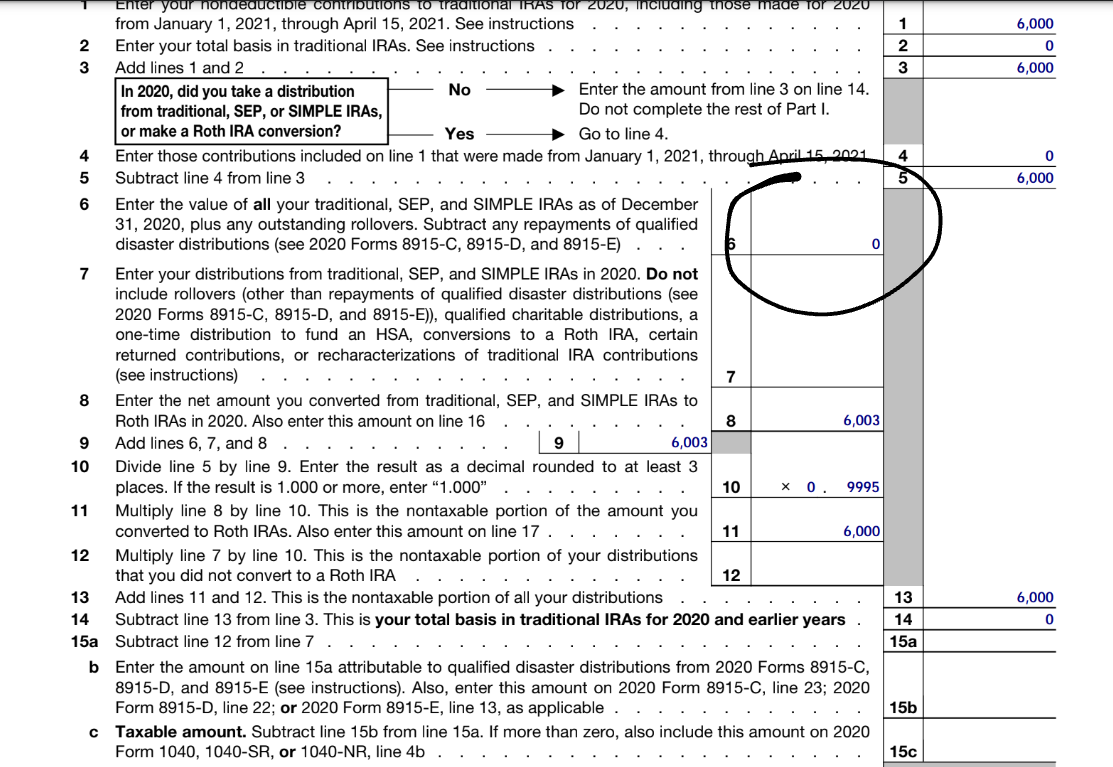
Betsy has successfully executed a Backdoor Roth IRA. Here is what page 1 of the Form 8606 Betsy should file with her 2021 income tax return should look like.
Notice here that I am using the 2020 version of the Form 8606 for this and all examples. The 2021 Form 8606 is not yet available as of this writing.
The most important line of page 1 of the Form 8606 is line 6. Line 6 reports the fair market value of all traditional IRAs, SEP IRAs, and SIMPLE IRAs Betsy owns as of year-end. Because Betsy had no traditional IRAs, SEP IRAs, and SIMPLE IRAs as of December 31, 2021, her Backdoor Roth IRA works and is tax efficient. This important number ($0) on line 6 of the Form 8606 is what ensures Betsy’s Backdoor Roth IRA is tax efficient.
Note that Betsy’s Backdoor Roth IRA creates an innocuous $3 of taxable income, which is reported on the top of part 2 of the Form 8606.
The Pro-Rata Rule and December 31st
But what if Betsy did have a balance inside a traditional IRA, SEP IRA, or SIMPLE IRA on December 31, 2021? Would her Backdoor Roth IRA still be tax efficient? Probably not, due to the Pro-Rata Rule.
The Pro-Rata Rule tells us just how much of the basis in her traditional IRA Betsy can recover when she does the Roth conversion step of the Backdoor Roth IRA. Betsy’s $6,000 nondeductible traditional IRA creates $6,000 of basis. As we saw above, Betsy was able to recover 100 percent of her $6,000 of basis against her Roth conversion.
But the Pro-Rata Rule says “not so fast” if Betsy has another traditional IRA, SEP IRA, or SIMPLE IRA on December 31st of the year of any Roth conversion. The Pro-Rata Rule allocates IRA Basis between converted amounts (in Betsy’s case, $6,003) and amounts in traditional IRAs, SEP IRAs, and SIMPLE IRAs on December 31st. Here’s an example.
Example 2
Betsy, age 40, earns $300,000 from her W-2 job in 2021, is covered by a workplace 401(k) plan, and has some investment income. Betsy has no balance in a traditional IRA, SEP IRA, or SIMPLE IRA.
Betsy contributes $6,000 to a traditional IRA on May 20, 2021. The contribution is nondeductible. Because the contribution is nondeductible, Betsy gets a $6,000 basis in her traditional IRA. Betsy must file a Form 8606 with her 2021 tax return to report the nondeductible contribution.
On June 5, 2021, Betsy converts the entire balance in the traditional IRA, $6,003, to a Roth IRA.
On September 1, 2021, Betsy transfers an old 401(k) from a previous employer 401(k) plan to a traditional IRA. On December 31st, that traditional IRA is worth $100,000. The old 401(k) had no after-tax contributions.
This one 401(k)-to-IRA rollover transaction dramatically changes both the taxation of Betsy’s Backdoor Roth IRA and her 2021 Form 8606. Here’s page 1 of the Form 8606.
Line 6 of the Form 8606 now has $100,000 on it instead of $0. That $100,000 causes Betsy to recover only 5.67 percent of the $6,000 of basis she created by making a nondeductible contribution to the traditional IRA. As a result, $5,663 of the $6,003 transferred to the Roth IRA in the Roth conversion step is taxable to Betsy as ordinary income. At a 35% tax rate, the 401(k) to IRA rollover (a nontaxable transaction) cost Betsy $1,982 in federal income tax on her Backdoor Roth IRA. Ouch!
Quick Lesson: The lesson here is that prior to rolling over a 401(k) or other workplace plan to an IRA, taxpayers should consider the impact on any Backdoor Roth IRA planning already done and/or planned for the future. One possible planning alternative is to transfer old employer 401(k) accounts to current employer 401(k) plans.
There is an antidote to the Pro-Rata Rule when one has amounts in traditional IRAs, SEP IRAs, and SIMPLE IRAs. It is transferring the traditional IRA, SEP IRA, or SIMPLE IRA to a qualified plan (such as a 401(k) plan) before December 31st. Here is what that might look like in Betsy’s example.
Example 3
Betsy, age 40, earns $300,000 from her W-2 job in 2021, is covered by a workplace 401(k) plan, and has some investment income. Betsy has no balance in a traditional IRA, SEP IRA, or SIMPLE IRA.
Betsy contributes $6,000 to a traditional IRA on May 20, 2021. The contribution is nondeductible. Because the contribution is nondeductible, Betsy gets a $6,000 basis in her traditional IRA. Betsy must file a Form 8606 with her 2021 tax return to report the nondeductible contribution.
On June 5, 2021, Betsy converts the entire balance in the traditional IRA, $6,003, to a Roth IRA.
On September 1, 2021, Betsy transfers an old 401(k) from a previous employer to a traditional IRA. The old 401(k) had no after-tax contributions.
On November 16, 2021, Betsy transfers the entire balance in this new traditional IRA to her current employer’s 401(k) plan in a direct trustee-to-trustee transfer.
Here is Betsy’s 2021 Form 8606 (page 1) after all of these events:
Betsy got clean by December 31st, so her Backdoor Roth IRA now reverts to the optimized result (just $3 of taxable income) she obtained in Example 1.
Pro-Rata Rule Clean Up
Implementation
From a planning perspective, it is best to clean up old traditional IRAs/SEP IRAs/SIMPLE IRAs prior to, not after, executing the Roth conversion step of a Backdoor Roth IRA. I say that because things happen in life. There is absolutely no guarantee that those intending to roll amounts from IRAs to workplace qualified plans will get that accomplished by December 31st.
Further, transfers from one retirement account to another are usually best done through a direct “trustee-to-trustee” transfer to minimize the risk that the money in the retirement account accidentally is distributed to the individual, causing potential tax and penalties.
Before cleaning up old traditional IRAs, SEP IRAs, and SIMPLE IRAs, one should consider the investment choices and fees inside their employer retirement plan (such as a 401(k)). If the investment options are not good, and/or the fees are high, perhaps cleaning up an IRA to move money into less desirable investments is not worth it. This is a subjective judgment that must weigh the potential tax and investment benefits and drawbacks.
Tax Issues
Amazingly enough, the Pro-Rata Rule is concerned with only one day: December 31st. A taxpayer can have a balance in a traditional IRA, SEP IRA, or SIMPLE IRA on any day other than December 31st, and it does not count for purposes of the Pro-Rata Rule. Perhaps December 31st should be called Pro-Rata Rule Day instead of New Year’s Eve. 😉
Extra care should be taken when cleaning up (a) large amounts in any type of IRA and (b) any SIMPLE IRA. While it is fairly obvious that significant sums should be moved only after considering all the relevant investment, tax, and execution issues, the SIMPLE IRA provides its own nuances. Any SIMPLE IRA cannot be rolled to an account other than a SIMPLE IRA within the SIMPLE IRA’s first two years of existence. Thus, SIMPLE IRAs must be appropriately aged before doing any sort of Backdoor Roth IRA clean up planning.
Spouses are entirely separate for Pro-Rata Rule purposes, even in community property states. Cleaning up one spouse, or failing to clean up one spouse, has absolutely no impact on the taxation of the other spouse’s Backdoor Roth IRA.
Lastly, non spousal inherited IRAs do not factor into a taxpayer’s application of the Pro-Rata Rule. Each non spousal inherited IRA has its own separate, hermetically sealed Pro-Rata Rule calculation. The inheriting beneficiary does a Pro-Rata Rule calculation on all IRAs he/she owns as the original owner, separate from any inherited IRAs. In addition, non spousal inherited IRAs cannot be rolled into a 401(k).
Mega Backdoor Roth
Good news: the concerns addressed in this blog post generally do not apply with respect to the Mega Backdoor Roth (sometimes referred to as a Mega Backdoor Roth IRA, though a Roth IRA does not necessarily have to be involved). Qualified plans such as 401(k)s are not subject to the Pro-Rata Rule.
While 401(k)s are not subject to the Pro-Rata Rule, amounts within a particular 401(k) plan’s after-tax 401(k) are subject to the “cream-in-the-coffee” rule I previously wrote about here. Thus, if there is growth on Mega Backdoor Roth contributions before they are moved out of the after-tax 401(k), generally speaking either the taxpayer must pay income tax on the growth (if moved to a Roth account) or the taxpayer can separately roll the growth to a traditional IRA (which could then create a rather small Pro-Rata Rule issue with future Backdoor Roth IRAs). Fortunately, the cream-in-the-coffee rule has a much narrower reach than the Pro-Rata Rule.
Backdoor Roth IRA Tax Return Reporting
Watch me discuss Backdoor Roth IRA tax return reporting.
Conclusion
Get your IRAs in order so you can enjoy New Year’s Eve!
December 31st is an important date when it comes to Backdoor Roth IRA planning. It is important to plan to have no (or at a minimum, very small) balances in traditional IRAs, SEP IRAs, and SIMPLE IRAs on December 31st when planning Backdoor Roth IRAs.
None of what is discussed in this blog post is advice for any particular taxpayer. Those working through Backdoor Roth IRA planning issues are often well advised to reach out to professional advisors regarding their own tax situation.
Further Reading
I did a blog post about Backdoor Roth IRA tax return reporting here.
I did a deep dive on the taxation of Roth IRA withdrawals here.
This post is for entertainment and educational purposes only. It does not constitute accounting, financial, investment, legal, or tax advice. Please consult with your advisor(s) regarding your personal accounting, financial, investment, legal, and tax matters. Please also refer to the Disclaimer & Warning section found here.
Is the backdoor closing? If a recently released proposal from the House Ways & Means Committee is enacted, then yes it is.
My analysis and commentary below is just my initial take on the proposed new laws: it is subject to revision.
UPDATE December 18, 2021
The update as of December 18, 2021 can be read here. Turns out that as of now (December 18th) my predictive analysis offered in November appears rather spot on. But remember, things can change.
Here’s what I wrote in November: On November 19, 2021, the House of Representatives passed the proposals discussed below. To my mind, the passage of this legislation is a 26.2 mile marathon: Passage in the House is the first mile, and passage in the Senate is the next 25.2 miles. There are absolutely no guarantees as to whether the proposals ultimately become law. My view is that passage in the Senate is going to be much more difficult than passage in the House.
Backdoor Roths
The Backdoor Roth IRA has been a popular transaction for over a decade. It allows those unable to make a direct Roth IRA contribution to get an annual contribution into a Roth IRA through a two-step process. There is a 401(k) version popularly referred to as the Mega Backdoor Roth IRA, which allows taxpayers to move significant amounts into Roth accounts using after-tax 401(k) contributions.
House Ways & Means Proposal
On September 13, 2021, the House Ways and Means committee released legislative text and an explanation of proposed new rules that would change the Roth landscape.
Elimination of Backdoor Roth IRAs and Mega Backdoor Roth IRAs
Effective in 2022, after-tax amounts in IRAs could not be converted to Roth IRAs. This rule would apply to all taxpayers regardless of their level of adjusted gross income. This rule would eliminate the Backdoor Roth IRA, as amounts contributed to a nondeductible traditional IRA (the first step of a Backdoor Roth IRA) could not be converted to a Roth IRA.
The bill would also eliminate after-tax contributions to qualified plans. As a result, workplace plans such as 401(k)s could no longer offer the Mega Backdoor Roth.
Effect on 2021 Backdoor Roth IRAs
In a twist, the new rule would effectively impose a deadline on all 2021 Backdoor Roth IRA planning: December 31, 2021. If the new law is passed, both the nondeductible traditional IRA contribution step and the Roth conversion step for a Backdoor Roth IRA would need to be completed by 2021 in order to do a 2021 Backdoor Roth IRA.
Usually, the deadline to worry about from a Backdoor Roth IRA perspective is the deadline to make the nondeductible traditional IRA contribution, usually April 15th of the following year. There is no particular deadline to complete the Roth conversion step. By prohibiting Roth conversions of after-tax money in traditional IRAs beginning January 1, 2022, Congress effectively makes December 31, 2021 the deadline to execute the Roth conversion step of a 2021 Backdoor Roth IRA.
I wrote about how the legislative proposal impacts the approach to 2021 Backdoor Roth IRA planning and deadlines here.
I have previously written about late or “split-year” Backdoor Roth IRAs under current law here.
Update on Legislative Proposals (As of November 4, 2021)
On October 28th, a new tax proposal came out which did not have the Backdoor elimination proposals. However, a second new tax proposal issued on November 3rd did contain the Backdoor Roth elimination proposals. Based on the current political landscape, there is significant doubt as to whether any tax proposal is enacted during this Congress. However, there is at least some chance the Backdoor Roth proposals are enacted.
Elimination of Roth Conversions for High Income Taxpayers Beginning in 2032
The legislative proposal also eliminates Roth conversions in any year a taxpayer’s adjusted taxable income is $400K (single filers) or $450K (married filing joint) starting in the year 2032.
A couple of observations about this rule. First, this rule would have no practical effect on the FI community. Usually, those in the FI community avoid taxable Roth conversions during high income years. Taxable Roth conversions (such as the so-called Roth Conversion Ladder strategy) are usually executed during early retirement before collecting Social Security. Those years often have artificially low taxable income, so a high income cap on the ability to do a Roth conversion is a rule without consequence for the FI community.
Second, you might be wondering: why the heck are they changing the tax law 10 years in the future? Why not now? The answer lies in how Congress “scores” tax bills. Taxable Roth conversions, particularly in the near term, increase tax revenue. An immediate repeal of Roth conversions would “cost” the government money in the new few years. But by delaying implementation for 10 years, Congress is able to predict that taxpayers, facing a future with no Roth conversions, will increase Roth conversions in 2030 and 2031, increasing tax revenues in those years.
Outlook
Congress is closely divided. There is absolutely no guarantee this bill will pass both houses of Congress and be signed by the President. That said, these proposed rules are now “out there” and being “out there” is the first step towards a tax rule becoming law.
I will Tweet and blog about any future developments in this regard.
FI Tax Guy can be your financial advisor! Find out more by visiting mullaneyfinancial.com
This post is for entertainment and educational purposes only. It does not constitute accounting, financial, investment, legal, or tax advice. Please consult with your advisor(s) regarding your personal accounting, financial, investment, legal, and tax matters.Please also refer to the Disclaimer & Warning section found here.
Tax deductions can be a confusing topic considering the many types of tax deductions and the terminology for them. Below I explain the different types of tax deductions you can claim on your tax return. You may be taking several of these types without even knowing it.
Types of Individual Tax Deductions
Exclusions
Many things we think of tax deductions are not treated as tax deductions on a tax return. Instead, they are excluded from taxable income. An exclusion from taxable income has the exact same effect as a tax deduction.
The most common exclusion is the exclusion for employer provided benefits, including health insurance, retirement plan contributions, and health savings accounts contributions. Here is an example:
Example: Mark has a salary of $100,000. He contributes ten percent ($10,000) of his salary to his employer’s 401(k) plan. His W-2 for the year will report wages of $90,000, not $100,000, and he will enter $90,000 as wages on his Form 1040. The $10,000 Mark contributed to his 401(k) is excluded from his gross income. This exclusion has the same income tax effect as a deduction.
Exclusions are a great form of deduction in that they are generally unlimited on your tax return, though they may have their own limitations. For example, in 2021 the most an employee under age 50 can exclude for contributions to a 401(k), 403(b), or a 457 is $19,500.
For those at least 70 1/2 years old, the qualified charitable distribution (“QCD”), which I wrote about here, can be a great tax planning technique.
Exclusions also reduce adjusted gross income (“AGI”). Items that reduce AGI are great because AGI (or modified AGI, “MAGI”) is usually the measuring stick for whether a taxpayer qualifies for many tax benefits (such as eligibility for making a deductible contribution to an IRA or making a contribution to a Roth IRA). Lowering AGI is an important tax planning objective, since lower AGI opens the door to several tax benefits.
Business Deductions
Business deductions include trade or business deductions generated from self-employment and investments in partnerships and rental property. On a Form 1040, these deductions are reported on Schedule C or Schedule E. Business deductions include salaries, rent, depreciation (deducting the cost of a business asset over a useful life), and other ordinary and necessary expenses.
Business deductions are generally great tax deductions because they are subject to relatively few limitations on your tax return. That said, limitations such as the passive activity loss rules and the at-risk limitations can limit a taxpayer’s ability to claim some business losses. Further, business deductions reduce not only income tax but also self-employment income, and thus, self-employment tax.
Business deductions are also valuable because they reduce AGI.
“For AGI” or “Above the Line” Deductions
On your Form 1040 you deduct certain expenses from your gross income to determine your AGI. Prior to tax returns filed for 2018 and later, these deductions were at the bottom of page 1 of the Form 1040. Starting with tax returns for 2018, these deductions are presented on Schedule 1 which accompanies Form 1040.
Examples of these deductions include one-half of self-employment tax paid by self-employed individuals, deductible contributions to IRAs, and contributions to certain self-employed retirement plans.
Capital losses, generally up to $3,000 on any one tax return, can be deducted for computing AGI. Capital losses in excess of $3,000 are carried over to future tax years to be deducted against capital gains and against up to $3,000 per year of ordinary income.
Health Savings Accounts (“HSAs”) are their own special breed. If contributions to an HSA are made through workplace payroll withholding, they are excluded from taxable income. If contributions to an HSA are made through another means (such as a check or wire transfer to the HSA), the contributions are for AGI deductions reported on Schedule 1. Which is better? From an income tax perspective, there is no difference. But from a payroll tax perspective, using payroll withholding is the clear winner. Amounts contributed to an HSA through payroll withholding are not subject to the FICA tax, creating another HSA tax win!
Standard Deduction or Itemized Deductions
Tax reform changed the landscape of itemized deductions. As a result of the tax reform bill enacted in December 2017, far fewer taxpayers will claim itemized deductions, and will instead claim the standard deduction.
The most common itemized deductions are state and local taxes (income, property, and in some cases, sales taxes), charitable contributions, and mortgage interest.
Taxpayers generally itemize if the sum total of itemized deductions (reported on Schedule A) exceed the standard deduction. Tax reform did two things to increase the chance that the standard deduction will exceed a taxpayer’s itemized deductions. First, the amount of the standard deduction increased. It went from $6,350 for single taxpayers in 2017 to $12,000 for single taxpayers in 2018. For married filing joint taxpayers, the standard deduction went from $12,700 in 2017 to $24,000 in 2018.
The standard deduction for 2021 is $12,550 (single) and $25,100 (MFJ) for most taxpayers.
In addition, several itemized deductions were significantly reduced. For example, starting in 2018 there is a deduction cap of $10,000 per tax return ($5,000 for married filing separate tax returns) for state and local taxes. This hits married taxpayers particularly hard and increases the chance that if you are married filing joint you will claim the standard deduction, since you will need over $15,100 in other itemized deductions to itemize (using the 2021 numbers).
In addition, miscellaneous deductions, such as unreimbursed employee expenses and tax return preparation fees, were eliminated as part of tax reform.
Thus, many taxpayers will find that they will often claim the standard deduction. As discussed below, there will be planning opportunities for taxpayers to essentially push many itemized deductions (such as charitable contributions) into one particular tax year, itemize for that year, and then claim the standard deduction for the next several years.
Neither the standard deduction nor itemized deductions reduce AGI.
Special Deductions
In a relatively new development in tax law, there are now deductions that apply only after AGI has been determined and separate and apart from the standard deduction or itemized deductions.
QBI Deduction
Tax reform created an entirely new tax deduction: the qualified business income deduction (also known as the QBI deduction or the Section 199A deduction). I have written about the QBI deduction here and here. Subject to certain limitations, taxpayers can claim, as a deduction, 20 percent of qualified business income, which is generally income from domestic business activities (not wage income), income from publicly-traded partnerships, and qualified REIT (real estate investment trust) dividends.
The QBI deduction does not reduce AGI.
Taxpayers can claim the QBI deduction regardless of whether they elect itemized deductions or the standard deduction.
Special Deduction for Charitable Contributions
For the 2021 tax year, taxpayers who do not claim itemized deductions are eligible for a special deduction for charitable contributions. The deduction is limited to $300 for single filers and $600 for MFJ filers.
As discussed by Jeffrey Levine, this deduction, like the QBI deduction, neither reduces AGI nor is an itemized deduction.
The statutory language for this new deduction is found at Section 170(p). I believe that there is a very good chance that this deduction is extended to years beyond 2021, though as of now, it is only applicable to the 2021 tax year.
Planning
Tax deductions provide a great opportunity for impactful tax planning. Here are some examples.
Timing
If your marginal income tax rate is the same every year, then you generally want to accelerate deductions. Thus, if you have a sole proprietorship and are a cash basis taxpayer, you are generally better off paying rent due on January 1, 2022 on December 31, 2021 instead of January 1, 2022 since the deduction saves the same amount of tax regardless of which tax year you pay it, but you’ll get the cash tax benefit sooner – on your 2021 income tax return instead of on your 2022 income tax return.
But there can be situations where you anticipate that your marginal tax rate will be greater next year than this year. In those cases, it makes sense to delay deductions. For example, perhaps you would make a large charitable contribution next year instead of before the end of the current year. Or, in the above example, you would pay the rent on January 1, 2022 to ensure the deduction is in 2022 instead of 2021.
Bunching
For some taxpayers, it may make sense to bunch deductions to maximize the total benefit of itemizing deductions versus claiming the standard deduction over several years. My favorite example of this is the donor advised fund. I’m not alone in my fondness of the donor advised fund. It allows you to contribute to a fund in one year, claim a charitable deduction for the entire amount of the contribution, and then donate from that fund to charities in subsequent years. The big advantage is that you get an enhanced upfront deduction in the first year and then claim the standard deduction in several subsequent years. This strategy only works if the amount of the deduction for the contribution to the donor advised fund is sufficient such that your itemized deductions in the year of the contribution exceed the standard deduction by a healthy amount.
Deadlines, Deadlines, Deadlines!!!
Different deductions have different deadlines. Many deductions have December 31st deadlines, so it is important to make the contribution by year-end. For charitable contributions, it is best to make the contribution online with a credit or debit card before January 1st if you are running really late, though if you place the contribution in a U.S. Postal Service mailbox prior to January 1st that counts as prior to the near year (though it makes it harder to prove you beat the deadline if you drop it in the mailbox on December 31st).
For employee contributions to a 401(k), the deadline is December 31st. Thus, if you are reading this on December 5th and you want to significantly increase your 401(k) contribution for 2021, you ought to get in touch with your payroll administrator and increase your contribution rate for your last paycheck ASAP.
By contrast, the deadline for a 2021 contribution to a deductible IRA or a non-payroll 2021 contribution to a HSA is April 15, 2022 (the date tax returns are due).
Tax deductions present several important tax planning considerations. These considerations should include the taxpayer’s current marginal tax rate and future marginal tax rate. They should also include consideration of maximizing the combination of itemized deductions and the standard deduction over multiple taxable years.
FI Tax Guy can be your financial planner! Find out more by visiting mullaneyfinancial.com
This post is for entertainment and educational purposes only. It does not constitute accounting, financial, investment, legal, or tax advice. Please consult with your advisor(s) regarding your personal accounting, financial, investment, legal, and tax matters. Please also refer to the Disclaimer & Warning section found here.
The Roth IRA: tax free retirement income. What’s not to love?
But wait a minute. What Congress gives Congress can take away, right? Might Congress, looking for tax revenues to pay off the debt, simply make Roth distributions in retirement taxable? Not very likely.
While I have no evidence to support this proposition, my guess is that Roth account owners vote at very high rates. Voting to tax Roth withdrawals in retirement seems to be a good way to create a motivated constituency to deny members of Congress re-election. I’m hardly the first person to argue that it is very unlikely that Congress will ever subject Roth withdrawals to income taxation.
The Value Added Tax
There are indirect ways for Congress to attack Roths and tax some of that otherwise tax free account value. One way some worry about is the value-added tax, otherwise known as the VAT. The VAT is a consumption tax on goods and services. The EU has a website here describing the VAT in the European Union. A VAT functions like a sales tax and can be added at any or all levels of production. Many developed countries have a VAT, but the United States does not.
Roths and the VAT
A VAT has the potential to increase the price of goods and/or services, and thus, to potentially eat away at value inside Roth accounts.
Here is a simplified example of how that would work.
Maria is retired. Her annual consumption is approximately $95,000, $5,000 of which is property taxes. She lives off $25,000 a year in Social Security income and $70,000 a year in withdrawals from her Roth IRA. She pays no income taxes on those withdrawals. If a 10 percent VAT were enacted on retail sales, she would need to withdraw approximately $9,000 (10 percent of her current $90,000 non-property tax annual consumption) more from her Roth IRA to pay for her current level of consumption. Instead of using an income tax, the government collects $9,000 from her Roth IRA annually by imposing a VAT.
The VAT functions as a tax on a Roth IRA. As Maria has to withdraw more from her Roth to maintain the same level of consumption, the VAT also reduces the value of amounts inside a Roth IRA. Does this mean a Roth IRA is less desirable?
For the reasons argued below, I believe that the answer is No. First, it should be remembered that were a VAT to be implemented, is almost certain to be implemented in addition to the current federal income tax. Sure, if the United States were to switchfrom an income tax to a VAT traditional IRA owners would win big (having previously received an income tax deduction without a later income tax charge) and Roth IRA owners would lose big. But a switch from an income tax to a VAT is almost certainly not happening.
Second, when assessing the value of Roth accounts in a United States with a VAT, one must compare them to the alternatives: traditional retirement accounts and taxable accounts.
Traditional Versus Roth with a VAT
Let’s start out by examining the difference between a Roth IRA and a traditional IRA if there is a federal VAT. Here is an example.
Joe is 65 years old and retired. He is a lifelong New York Jets fan, and decides he wants to go Super Bowl LVI, to see his Jets, presumably the AFC representatives in the game. One ticket costs $10,000 and Joe’s only source of funds for the purchase is his retirement account. Joe’s marginal federal income tax rate is 22 percent. Here are the results if Joe has a traditional IRA and a Roth IRA both without a federal VAT on the ticket and with a 5 percent federal VAT on the ticket:
No VAT
No VAT
5% VAT
5% VAT
IRA Type
Amount Needed
Income Tax Due
Amount Needed
Income Tax Due
Traditional
$12,821
$2,821
$13,462
$2,962
Roth
$10,000
$0
$10,500
$0
Hopefully you can see what is going on in the table. With a traditional IRA, one cannot simply withdraw $10,000 to pay for a $10,000 expense. There will be income tax due on the withdrawal. In order to net out $10,000 to pay for the ticket, Joe must withdraw $12,821, which covers the cost of the ticket and the 22 percent federal income tax (assume Joe lives in Florida so there’s no state income tax). This is computed as the amount needed ($10,000) divided by 1 minus the tax rate (1 minus .22), which equals $12,821.
With a 5 percent VAT, Joe must pay $10,500 for the Super Bowl ticket. From his traditional IRA, he must withdraw $13,462, computed as the amount needed ($10,500) divided by 1 minus the tax rate (1 minus .22).
As we are about to learn, paying a VAT with a traditional IRA creates a new tax: income tax on the VAT. Paying a VAT with a Roth IRA avoids this new tax.
If Joe pays for his Super Bowl ticket with a traditional IRA, he needs $641 more from his traditional IRA in a VAT environment to pay for the Super Bowl ticket. He must pay $141 in additional income tax to cover this additional withdrawal. The income tax on the VAT is $110 (22 percent of $500), the income tax on the income tax on the VAT is $24 (22 percent of $110), and there is approximately $7 of income tax on the remainder of the income tax required.
See this spreadsheet for the income tax calculation. Incredibly, it is possible to pay income tax on the income tax on the income tax on the income tax on the VAT if you pay the VAT from a traditional IRA. It will get much worse as expenses increase beyond the $10,000 tackled in this example.
The first lesson: a VAT hurts those with traditional IRAs, since they will have to increase their taxable withdrawals to pay for goods and services subject to the VAT. When paid with a traditional retirement account, VAT creates several new taxes: the VAT itself, the income tax on the VAT, the income tax on the income tax on the VAT, etc.
The second lesson: if a VAT is enacted, the Roth protects retirees from the income tax payable on the VAT. The 5 percent VAT increases the total tax cost of the $10,000 ticket by $641 if one uses a traditional IRA but only by $500 if one uses a Roth IRA. Having a Roth protects against income tax on the VAT itself. This makes a Roth an even more desirable planning alternative if there is a VAT than if there is no VAT.
The income tax on the VAT is another tax villain the Roth can successfully defeat.
Roth Versus Taxable with a VAT
I believe the logic applied in the Roth versus Traditional VAT environment applies in assessing Roths versus taxable accounts in a VAT environment. To fund consumption, retirees will have to sell more of their taxable brokerage accounts to pay for the now increased price of goods and services, resulting in higher capital gains (and thus, more capital gains taxes) in many cases. Using a Roth withdrawal to pay a VAT protects against those additional capital gains taxes.
Planning
If one believes that a VAT is coming, there is not much, to my mind, to be done from a financial planning perspective, other than increasing amounts in Roth accounts. One might purchase durable goods in advance of the enactment of a VAT, but that sort of planning is of limited value. How many refrigerators can you stockpile for your future use? For those worried about a VAT, the tactics that appear effective are to increase Roth contributions and/or conversions.
While a VAT would not be good news, it makes the Roth planning decision more likely to be the advantageous planning decision.
Paying a VAT out of a Roth avoids the income tax on the VAT (and the resulting additional income taxes) retirees incur when paying the VAT out of a traditional IRA. A Roth also avoids increased capital gains taxes resulting from using taxable brokerage accounts to pay a VAT.
Conclusion
A VAT is not good news for Roth IRA owners, but it is worse news for traditional IRA owners. Roths limit the tax damage of a VAT to the VAT itself in a way neither traditional retirement accounts nor taxable accounts are capable of. In the age-old traditional versus Roth debate, the possibility of a future VAT moves the needle (if ever so slightly) in the direction of the Roth.
FI Tax Guy can be your financial planner! Find out more by visiting mullaneyfinancial.com
This post is for entertainment and educational purposes only. It does not constitute accounting, financial, investment, legal, or tax advice. Please consult with your advisor(s) regarding your personal accounting, financial, investment, legal, and tax matters. Please also refer to the Disclaimer & Warning section found here.
As always, the discussion is general and educational in nature and does not constitute tax, investment, legal, or financial advice with respect to any particular individual or taxpayer. Please consult your own advisors regarding your own unique situation.
FI Tax Guy can be your financial advisor! Find out more by visiting mullaneyfinancial.com
This post is for entertainment and educational purposes only. It does not constitute accounting, financial, investment, legal, or tax advice. Please consult with your advisor(s) regarding your personal accounting, financial, investment, legal, and tax matters.Please also refer to the Disclaimer & Warning section found here.